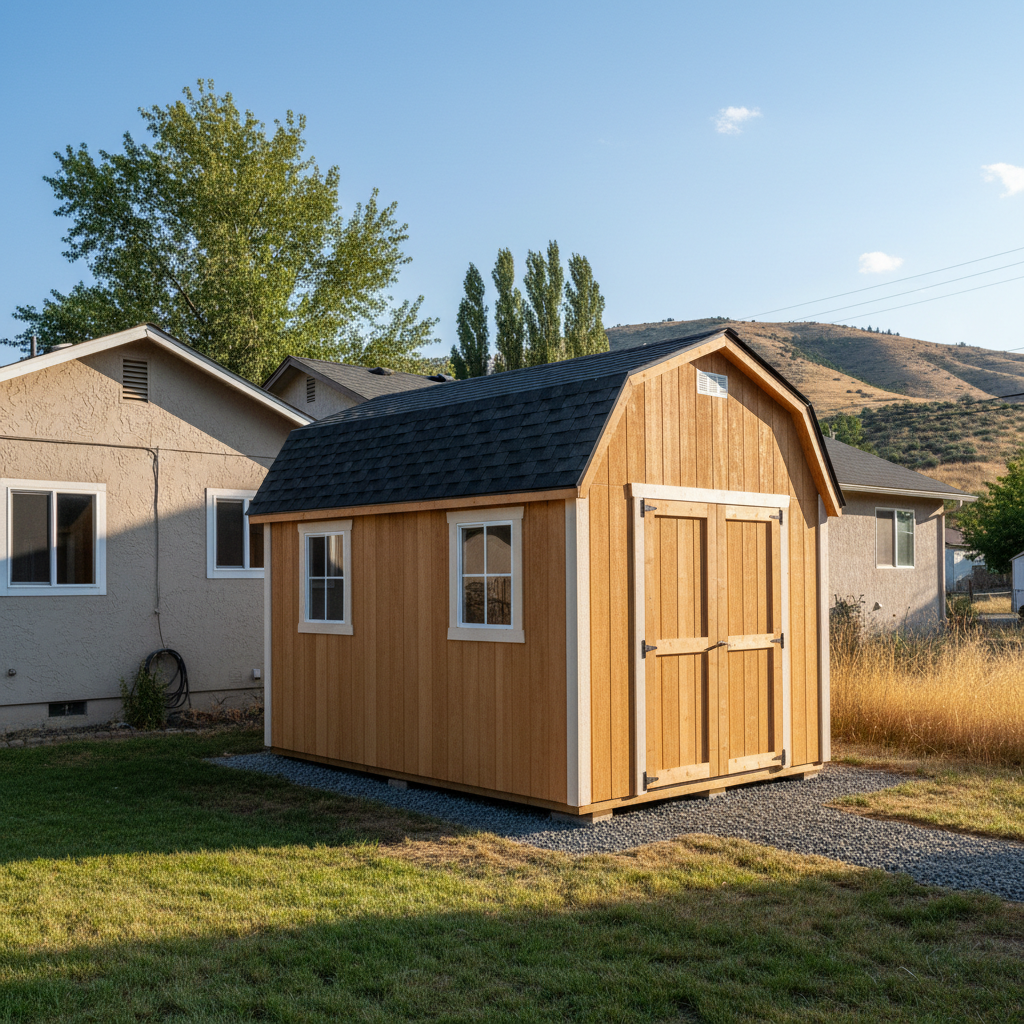
So, you’ve picked out a shed, maybe even designed it just right. That’s the fun part, right? But then comes the practical stuff: how do you get that thing from the shop to your backyard, and how much is it gonna cost to get it set up properly? It’s not always as simple as just dropping it off, and I’ve seen folks get sticker shock when they don’t understand all the moving parts. Let’s talk about what goes into shed delivery and installation costs right here in Kennewick.
What Makes the Price Tag Go Up or Down?
A few big things really move the needle on what you’ll pay for getting your shed delivered and installed. It’s not just a flat fee, believe me.
- Shed Size and Weight: This is probably the biggest one. A small 8x10 shed is a lot easier to move and set up than a massive 12x24 two-story workshop. Bigger sheds often need specialized equipment, more crew members, and more time. A standard 8x12 might be a couple hundred bucks for delivery, but a 12x24 could easily be $500 or more just for the haul.
- Site Accessibility: Can a truck and trailer easily back right up to where the shed needs to go? Or do we have to navigate tight corners, fences, steep slopes, or even lift it over obstacles? If we need to use a crane or a shed mule to get it into a tricky spot, that’s going to add to the cost. That can be an extra $100-$500, sometimes more for a crane. If your backyard is only accessible through a narrow gate, we might have to build it on-site, which is a different ballgame entirely.
- Foundation Type: Are we just dropping it on some gravel, or do you need a proper concrete slab? Most shed companies, including Kennewick Custom Sheds, will recommend a solid, level foundation. A basic gravel pad might add $300-$800 depending on size and site prep. A concrete slab? You’re looking at $1,000 to $3,000+ for a decent one, and that’s usually a separate contractor you’d hire. We’re talking about making sure your shed lasts, so don’t skimp here.
- Distance from the Shop: This one’s pretty straightforward. The further we have to drive, the more fuel and time it takes. Most local companies will have a free delivery radius, say 20-30 miles from their shop. Beyond that, you’ll pay a per-mile fee, often $3-$5 per mile. If you’re out past Finley or up toward Benton City, expect to see that mileage charge.
- On-Site Assembly vs. Pre-Built: Most of the sheds we deliver are pre-built, which is faster and often cheaper for you in the long run. If your site is truly inaccessible for a pre-built shed, or if you’ve chosen a custom design that’s too big to transport, then we’ll build it on-site. On-site assembly typically adds 15-30% to the total cost of the shed, sometimes more depending on complexity.
Typical Cost Ranges You’ll See
Alright, let’s get down to some real numbers for Kennewick and the surrounding areas. Keep in mind these are averages, and your specific situation will vary.
- Basic Delivery (Pre-Built Shed, Easy Access, within 30 miles): For an 8x10 or 10x12 shed, you’re usually looking at $150 - $400. This often includes basic leveling with shims on a prepared pad.
- Larger Shed Delivery (Pre-Built, Easy Access, within 30 miles): For a 10x16 or 12x20, expect $300 - $600.
- Tricky Site Delivery (Pre-Built, requires shed mule or extra labor): Add $200 - $700 on top of the base delivery fee. This is common if you’ve got a sloped yard or a tight squeeze around the side of your house.
- On-Site Assembly: If your shed needs to be built piece by piece in your backyard, you’re looking at an additional 15-30% of the shed’s purchase price. So, a $5,000 shed could have an extra $750 - $1,500 for assembly.
- Gravel Pad Foundation: Depending on the size and how much ground needs to be moved, a 4-6 inch gravel pad can run $300 - $800.
So, for a typical 10x12 shed, all-in delivery and installation (assuming a gravel pad and easy access) might be in the $500 to $1,200 range on top of the shed’s price. This doesn’t include concrete work, which is a whole other ball of wax.
What Should Be in Your Quote?
When you get a quote, make sure it’s clear and covers everything. A good quote from a reputable company like Kennewick Custom Sheds should explicitly state:
- Delivery Fee: The cost to transport the shed to your property.
- Installation/Set-Up Fee: What they charge to get it off the trailer, positioned, and leveled.
- Foundation Prep (if applicable): If they’re doing a gravel pad or blocks, that cost should be separate.
- Any Special Equipment Charges: If they need a shed mule, crane, or extra hands for a difficult spot, it should be itemized.
- Permit Responsibility: Who is responsible for getting any necessary permits? (Usually, that’s you, the homeowner, especially for larger sheds).
- Warranty Information: What’s covered for the installation?
Don’t just get a number. Get a breakdown. If it’s vague, ask questions until you understand every line item.
Don’t Overpay: Smart Moves for Your Wallet
Nobody wants to throw money away, especially on something as essential as a shed. Here’s how you can keep costs down and avoid surprises:
- Prepare Your Site: The cleaner and more level your site is, the less work we have to do. Clear out bushes, remove old concrete, and make sure there’s a clear path. If your yard is like a lunar landscape, we’ll have to charge for the extra prep.
- Measure Your Access: Seriously, measure your gates, the side of your house, any tight spots. Know exactly how wide and tall the path is. If you tell us it’s 10 feet wide, and we show up and it’s 8, that’s a problem and will cost you.
- Get Multiple Quotes: It’s always smart to compare. Just make sure you’re comparing apples to apples. One company might seem cheaper, but they might not include leveling or a proper foundation.
- Ask About Hidden Fees: Straight up ask, “Are there any other fees I should know about?” A good contractor will be transparent.
- Consider DIY for Smaller Sheds: If you’re handy and it’s a smaller, kit-style shed, you might save on assembly costs by doing it yourself. Just be honest about your skills and time.
Getting a shed is a great investment for your property, whether it’s for storage, a workshop, or a backyard office. Just make sure you understand all the costs upfront for delivery and installation. Do your homework, ask the right questions, and you’ll avoid any nasty surprises.